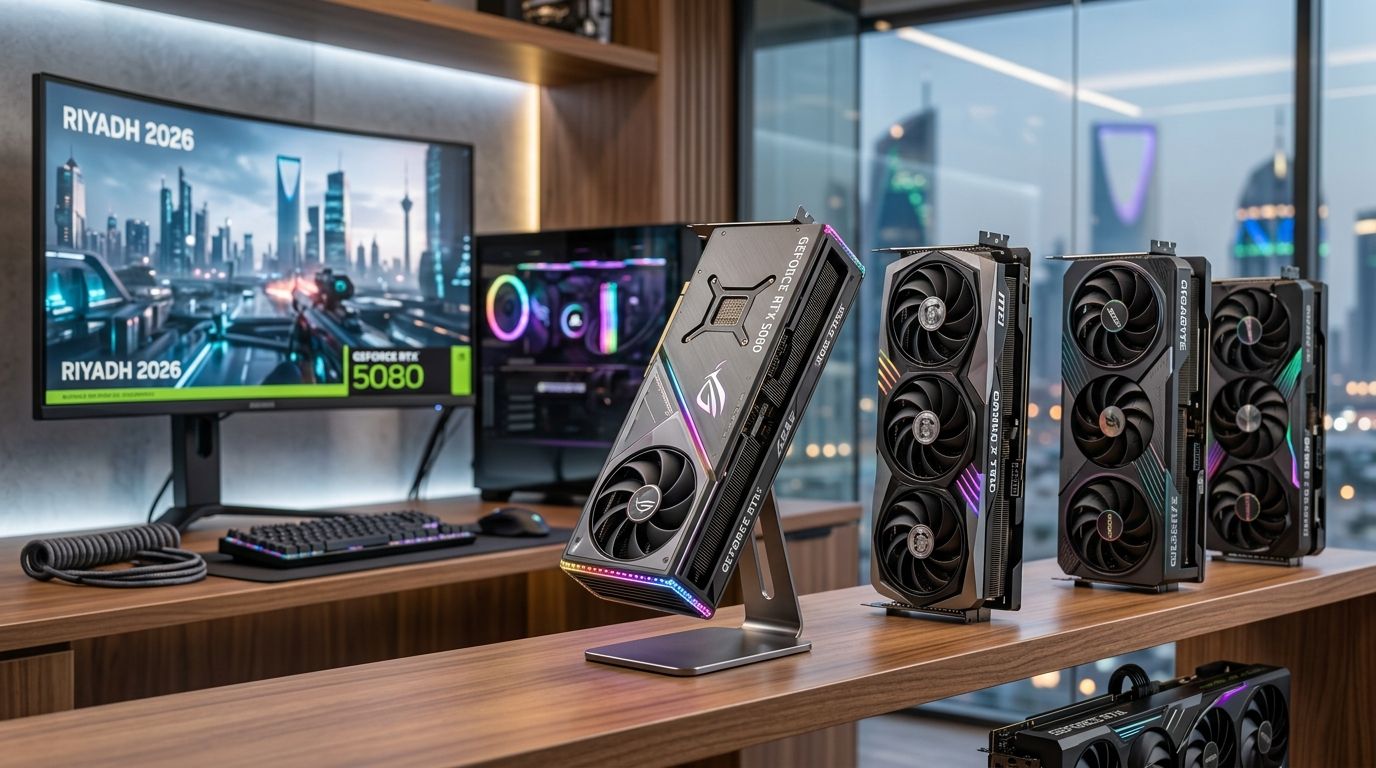
Best overall RTX 5080 in Saudi Arabia in 2026: the RTX 5080 Founders Edition. Best for overclocking headroom: the ASUS ROG Astral RTX 5080. Best for large-case 4K builds: the Gigabyte Aorus Master RTX 5080.
- RTX 5080 Founders Edition wins overall for gamers who want stock clocks and a compact dual-slot cooler.
- ASUS ROG Astral RTX 5080 leads for overclockers chasing extra 4K frames in 2026.
- Gigabyte Aorus Master RTX 5080 suits large towers with room for a triple-fan cooler.
- MSI Gaming Trio RTX 5080 keeps noise down under sustained 4K load.
- Zotac Gaming Trinity RTX 5080 fits small form factor cases better than triple-slot rivals.
Why this matters
Every RTX 5080 card ships with the same GPU die, the same 16GB of GDDR7 memory, and the same 256-bit bus, so the differences between models come down to cooling, clocks, size, and noise, not raw performance ceiling. Picking the wrong variant for your case or PSU headroom is the most common mistake gamers make when upgrading in 2026.
The RTX 5080 sits below the RTX 5090 in Nvidia's Blackwell lineup but well above last generation's RTX 4080 Super, and it draws roughly 360W of board power at stock settings, which matters for anyone reusing an older power supply. If you're comparing the full stack before you commit, Gamerzone's GPU lineup covers current-generation cards across price points.
What makes the best RTX 5080 graphics card
- Cooling design — dual-slot vs. triple-slot coolers change thermal headroom and case fit.
- Factory overclock — some AIB partners push boost clocks above Nvidia's reference spec out of the box.
- Physical dimensions — card length and slot width determine compatibility with mid-tower and small form factor cases.
- Noise under load — fan curve tuning varies sharply between Founders Edition and third-party coolers.
- Power connector and PSU headroom — a 360W typical board power draw needs a PSU with margin for transient spikes.
- Build quality and RGB — backplate rigidity and lighting customization matter for aesthetics-focused builds.
RTX 5080 cards at a glance
| Card | Best for | Standout feature | Key limitation |
|---|---|---|---|
| RTX 5080 Founders Edition | Overall balance | Compact dual-slot flow-through cooler | Limited factory overclock vs. AIB cards |
| ASUS ROG Astral RTX 5080 | Overclocking headroom | Reinforced power delivery for sustained boost clocks | Longer card length limits case options |
| Gigabyte Aorus Master RTX 5080 | Large-case 4K builds | Triple-fan cooler with high thermal ceiling | Triple-slot width blocks adjacent PCIe slots |
| MSI Gaming Trio RTX 5080 | Quiet operation | Tuned fan curve for lower noise under load | Larger footprint than Founders Edition |
| Zotac Gaming Trinity RTX 5080 | Small form factor cases | Shorter card length than most AIB variants | Less thermal margin for aggressive overclocking |
1. RTX 5080 Founders Edition: best RTX 5080 for balanced 4K gaming
Nvidia's own Founders Edition uses a dual-slot flow-through cooler design that keeps the card compact without sacrificing thermal performance at stock clocks. It runs the reference 10,752 CUDA cores and 16GB of GDDR7 memory with no factory overclock, which makes it the most predictable option for gamers who don't plan to tune voltage curves.
RTX 5080 Founders Edition pros:
- Compact dual-slot design fits most mid-tower cases
- Reference clocks mean predictable thermals and power draw
- Clean, understated build with minimal RGB
RTX 5080 Founders Edition cons:
- No factory overclock headroom compared to AIB variants
- Limited availability compared to third-party partner cards
Best for: gamers who want a no-fuss 4K card without tuning fan curves or voltage.
Verdict: Buy if you want the safest, most compact RTX 5080 in 2026.
2. ASUS ROG Astral RTX 5080: best RTX 5080 for overclocking headroom
The ROG Astral series is built around reinforced power delivery and a beefed-up VRM, aimed at gamers who plan to push boost clocks past reference specs. It carries the same 16GB GDDR7 memory pool as every other RTX 5080, but the extra power stages give it more sustained overclocking headroom than the Founders Edition.
ASUS ROG Astral RTX 5080 pros:
- Reinforced power delivery supports sustained factory and manual overclocks
- Larger triple-fan cooler handles higher sustained clocks
- Strong build quality with a rigid backplate
ASUS ROG Astral RTX 5080 cons:
- Longer card length reduces compatibility with compact cases
- Higher sustained power draw needs a PSU with real headroom above 360W
- Premium cooler adds bulk without a proportional gain at stock clocks
Best for: enthusiasts building a high-end 4K rig in 2026 who plan to overclock.
Verdict: Buy if you want the most overclocking headroom in the RTX 5080 lineup, and pair it with a case that has room to spare, or compare it against RTX 5090 gaming PCs if you want more raw ceiling.
3. Gigabyte Aorus Master RTX 5080: best RTX 5080 for large-case 4K builds
The Aorus Master uses a triple-fan cooler with a large heatsink footprint, designed to keep the RTX 5080 running cool under continuous 4K load. Its wider chassis takes up more room than the Founders Edition or ROG Astral, so it only makes sense in full-tower or larger mid-tower builds.
Gigabyte Aorus Master RTX 5080 pros:
- High thermal ceiling for sustained 4K gaming sessions
- Strong RGB customization through Gigabyte's control software
- Solid backplate construction reduces board flex
Gigabyte Aorus Master RTX 5080 cons:
- Triple-slot width blocks an adjacent PCIe slot on most motherboards
- Heaviest card in this list, which stresses PCIe slot retention over time
Best for: gamers with a full-tower case who prioritize thermals over compactness.
Verdict: Buy if your case has the clearance and you want maximum cooling margin.
4. MSI Gaming Trio RTX 5080: best RTX 5080 for quiet operation
The Gaming Trio's fan curve is tuned to keep noise down at moderate loads, ramping up only when temperatures climb closer to thermal limits. It sits between the Founders Edition and the larger triple-fan cards in size, offering a middle ground for gamers who don't want a triple-slot monster but still want more cooling than reference.
MSI Gaming Trio RTX 5080 pros:
- Noticeably quieter than reference designs at moderate load
- Balanced size fits more mid-tower cases than the ROG Astral or Aorus Master
- Solid factory tuning without needing manual fan curve adjustments
MSI Gaming Trio RTX 5080 cons:
- Less overclocking headroom than the ROG Astral's reinforced power delivery
- Still larger than the Founders Edition, so measure clearance first
Best for: gamers building in a shared room or streaming setup where fan noise matters.
Verdict: Buy if quiet operation matters more than maximum overclocking.
5. Zotac Gaming Trinity RTX 5080: best RTX 5080 for small form factor cases
The Gaming Trinity is the shortest card in this lineup, aimed at gamers building in compact or small form factor cases where card length is the limiting factor. It trades some thermal margin for a smaller footprint, so it's not the pick for aggressive manual overclocking.
Zotac Gaming Trinity RTX 5080 pros:
- Shortest card length among current RTX 5080 partner cards
- Fits small form factor and compact mid-tower builds other cards can't
- Lower weight reduces PCIe slot stress in vertical mount configurations
Zotac Gaming Trinity RTX 5080 cons:
- Less thermal headroom than triple-fan competitors under sustained load
- Fewer RGB customization options than Aorus Master or ROG Astral
Best for: small form factor builders who need every millimeter of case clearance.
Verdict: Buy if your case can't fit a triple-slot card, Skip if you're chasing overclocking headroom.
How we ranked these RTX 5080 cards
Each card was scored against the six criteria above: cooling design, factory overclock, physical dimensions, noise under load, power delivery, and build quality. Since every RTX 5080 shares the same 16GB GDDR7 memory and 10,752 CUDA core count, the ranking rewards cards that solve a specific build constraint rather than chasing marginal clock speed differences.
Which RTX 5080 should you choose?
If you're undecided, the RTX 5080 Founders Edition is the default pick in 2026 — it fits the widest range of cases and carries no compromises tied to a specific use case. Overclockers should move to the ASUS ROG Astral, and anyone with a full-tower case chasing maximum 4K thermals should look at the Gigabyte Aorus Master. If your budget or case size points you toward a step down, the RTX 5070 Ti is worth a look before you commit.
FAQ
What is the best RTX 5080 graphics card overall in 2026?
The RTX 5080 Founders Edition is the best overall pick in 2026 because its dual-slot cooler fits the widest range of PC cases without sacrificing thermal performance at stock clocks.
Is the RTX 5080 better than the RTX 5070 Ti?
The RTX 5080 carries more CUDA cores and the same 16GB GDDR7 memory pool, giving it a higher 4K performance ceiling than the RTX 5070 Ti, which suits gamers on a tighter case or power budget.
How much power does an RTX 5080 need?
The RTX 5080 has a typical board power of 360W, so a power supply with real headroom above that figure is recommended to handle transient spikes during gaming.
Does the RTX 5080 support DLSS 4?
Yes, the RTX 5080 is part of Nvidia's Blackwell generation and supports DLSS 4, including multi-frame generation, on titles that add the feature.
Which RTX 5080 card is best for small form factor cases?
The Zotac Gaming Trinity RTX 5080 has the shortest card length in this lineup, making it the best fit for compact and small form factor builds in 2026.
Is the RTX 5080 or RTX 5090 the better upgrade in 2026?
The RTX 5080 offers strong 4K performance at a lower power draw than the RTX 5090, while the RTX 5090 pushes further for gamers who want maximum headroom and don't mind a larger case and PSU.
One last thing
Every RTX 5080 variant shares the same 16GB GDDR7 memory and 10,752 CUDA cores, so the card you should buy in 2026 comes down to your case clearance and PSU headroom, not a hidden performance gap between partner brands.