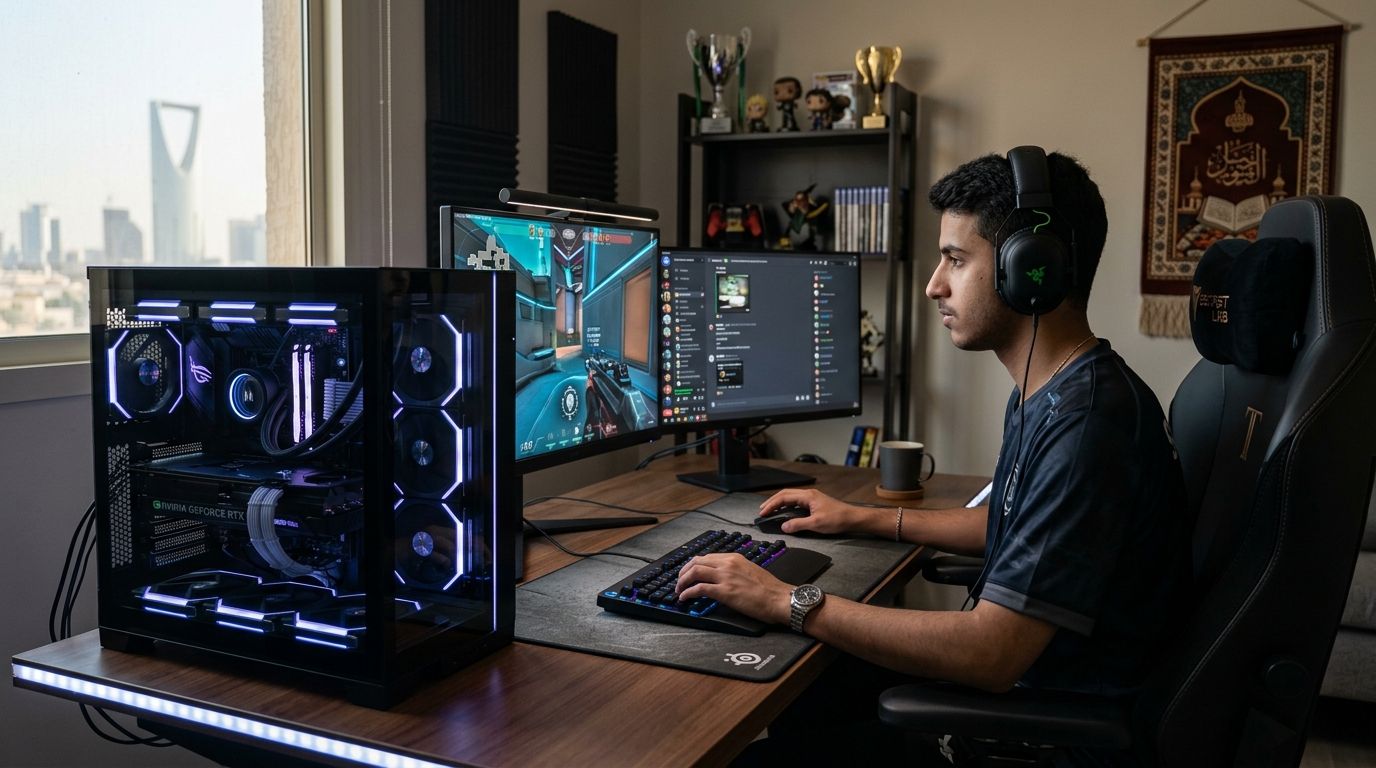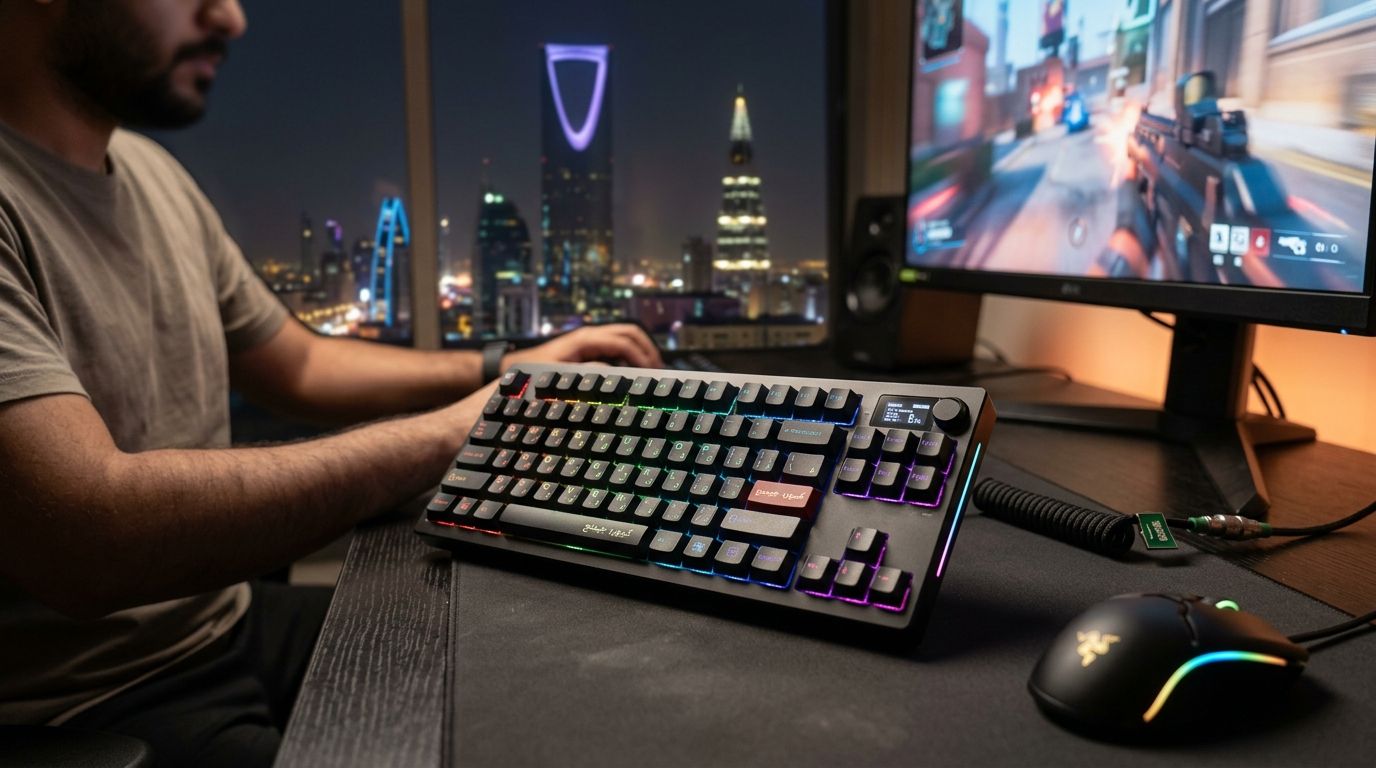
Picking the right gaming keyboard in 2026 comes down to switch type, polling rate, and desk space, not RGB marketing. This guide ranks the six categories of gaming keyboard that matter in Saudi Arabia right now and tells you which one fits your setup.
Best overall: full-size mechanical keyboards with hot-swappable switches. Best for competitive FPS: optical-switch keyboards with 1000Hz wired polling. Best budget option: membrane and hybrid-membrane keyboards.
- A hot-swappable full-size mechanical gaming keyboard is the best overall pick for 2026 — flexible switches, numpad included.
- Optical switch keyboards actuate faster than standard mechanical switches and suit competitive FPS players.
- TKL keyboards free up desk space for wide mouse swipes without losing key travel quality.
- Membrane and hybrid keyboards remain the realistic budget entry point for a first gaming keyboard.
- Wireless 2.4GHz mechanical keyboards now match wired input lag closely enough for most players.
Why this matters
A gaming keyboard is the one input device you touch on every match, every build session, every workday between games. Get the switch type wrong and you either fatigue your fingers or miss inputs in a firefight.
Gamerzone stocks a gaming accessories lineup covering keyboards alongside GPUs, monitors, and full builds, so the keyboard choice below should match whatever rig you're already running or planning for 2026.
The categories below aren't ranked by hype. They're ranked by what each switch type and form factor actually does to your input speed, desk footprint, and budget.
What makes the best gaming keyboard
- Switch type and actuation force — linear, tactile, or clicky, and how many grams of force it takes to register a keypress
- Polling rate — how often the keyboard reports input to your PC; 1000Hz wired is the 2026 baseline
- Build quality — plate material, hot-swap sockets, and case rigidity under repeated key mashing
- Keycap material — PBT resists shine and wear far longer than stock ABS caps
- Connectivity — wired USB, 2.4GHz wireless dongle, or Bluetooth, each with a different latency trade-off
- Anti-ghosting and rollover — how many simultaneous keypresses the keyboard registers correctly
At a glance
| Keyboard type | Best for | Standout feature | Key limitation |
|---|---|---|---|
| Full-size mechanical (hot-swap) | Overall gaming and productivity | Swappable switches without soldering | Takes more desk space than TKL |
| TKL / compact mechanical | Limited desk space | Full key travel in a smaller footprint | No dedicated numpad |
| Optical switch | Competitive FPS | Light-based actuation, no metal contact bounce | Fewer switch-feel options on the market |
| Wireless 2.4GHz mechanical | Cable-free, multi-device setups | Low-latency dongle matching wired feel | Battery needs regular charging |
| Low-profile mechanical | Fast typers, office-gaming crossover | Shorter travel reduces finger fatigue | Less tactile feedback for some gamers |
| Membrane / hybrid-membrane | Budget entry point | Lowest cost way into gaming peripherals | Shorter lifespan, mushier feel |
1. Full-size mechanical keyboard: best gaming keyboard for overall use
A full-size mechanical keyboard with hot-swappable sockets covers gaming, typing, and everyday desk work without compromise. Hot-swap sockets let you change switches without a soldering iron, so you can test linear, tactile, or clicky switches on the same board through 2026 and beyond.
Full-size mechanical pros:
- Numpad included for spreadsheet work and Discord shortcuts
- Hot-swap sockets mean you're not locked into one switch feel
- Sturdier plate construction than most budget boards
- Widest range of keycap and switch upgrade options
Full-size mechanical cons:
- Takes up the most desk real estate of any category here
- Heavier, less convenient to travel with to LAN events
Best for: gamers who also use the same desk for work or study. Verdict: Buy.
2. TKL mechanical keyboard: best gaming keyboard for tight desk space
Tenkeyless boards drop the numpad entirely, shrinking the footprint by roughly 20% while keeping full-size key switches and travel. That extra space goes straight to mouse swing room, which matters more than people expect at low DPI settings.
Pairing a TKL board with one of the gaming monitors in Saudi Arabia tracked for 2026 gives competitive players a cleaner desk setup without sacrificing input quality.
TKL pros:
- Frees up 15-20cm of lateral mouse space
- Easier to pack for LAN events and travel
- Same switch quality as full-size variants
TKL cons:
- No numpad, which slows down number entry
- Function row shortcuts sometimes replace dedicated keys
Best for: competitive players who prioritize mouse space over a numpad. Verdict: Buy.
3. Optical switch keyboard: best gaming keyboard for competitive FPS
Optical switches use a light beam instead of a metal contact point to register a keypress, which removes the debounce delay that mechanical switches need to filter out contact bounce. That shaves a small but real amount of input latency, which matters in frame-by-frame FPS duels.
Optical switch pros:
- No mechanical debounce delay to filter
- Longer switch lifespan since there's no physical metal contact wear
- Often available with adjustable actuation points on higher-end models
Optical switch cons:
- Fewer tactile and clicky switch-feel options than standard mechanical
- Typically a smaller market selection than Cherry MX-style switches
Best for: ranked FPS players chasing every millisecond of input speed. Verdict: Buy.
4. Wireless 2.4GHz mechanical keyboard: best gaming keyboard for cable-free setups
A proprietary 2.4GHz dongle connection now closes most of the latency gap that used to separate wireless from wired mechanical keyboards. Bluetooth mode stays useful for a second paired device, but the 2.4GHz dongle is the mode to use for actual gameplay.
Wireless 2.4GHz pros:
- Clean desk with no cable drag during fast mouse movements
- Dongle latency close enough to wired for most players in 2026
- Bluetooth mode adds a second device pairing option
Wireless 2.4GHz cons:
- Needs regular charging or battery swaps
- Slightly heavier than wired equivalents due to the battery
Best for: players who want one board across a PC and a second device. Verdict: Buy.
5. Low-profile mechanical keyboard: best gaming keyboard for office-gaming crossover
Low-profile switches shorten total key travel, which reduces finger fatigue over long work sessions and still registers gaming inputs cleanly. This category sits between a slim office keyboard and a full-height mechanical board.
Low-profile pros:
- Shorter travel reduces fatigue during long sessions
- Slimmer, more portable design
- Quieter than tall mechanical switches in shared spaces
Low-profile cons:
- Less tactile feedback than standard-height switches
- Fewer switch options available than full-height mechanical
Best for: hybrid work-and-game desks where fatigue matters more than raw speed. Verdict: Hold unless you already know you prefer shorter travel.
6. Membrane / hybrid-membrane keyboard: best budget gaming keyboard
Membrane keyboards use a rubber dome under each key instead of individual mechanical switches, which keeps manufacturing cost low. Hybrid-membrane designs add some mechanical-style feedback on top of the rubber dome layer to close part of the feel gap.
Membrane pros:
- Lowest-cost way to get RGB lighting and anti-ghosting on a keyboard
- Quieter operation than most mechanical switches
- Lighter weight for portability
Membrane cons:
- Shorter operational lifespan than mechanical switches
- Mushier feel that slows precise, repeated inputs
Best for: first-time gaming keyboard buyers on a tight budget. Verdict: Skip if you already own a mechanical board; Buy as a starter upgrade.
Browse Gamerzone's keyboard lineup
Compare switch types and connectivity before you build your 2026 setup.
How we ranked
Each category above was scored against the same six criteria: switch type and actuation force, polling rate, build quality, keycap material, connectivity, and rollover. Full-size mechanical wins overall because it scores well across every criterion at once, while the other five categories each win on one specific trade-off — desk space, raw speed, cable freedom, fatigue, or cost.
“If the switch needs less than 2mm of travel before it registers, you're trading feel for speed — decide which one your game actually rewards.”
Which gaming keyboard should you choose?
Go with a full-size hot-swappable mechanical keyboard if you want one board that handles ranked matches and daily typing without a second purchase. Drop to TKL or optical switches if competitive FPS is the only thing that matters and desk space is tight. Start with a membrane board only if this is your first keyboard purchase and budget is the deciding factor going into 2026.
FAQ
What's the best gaming keyboard in 2026?
A full-size mechanical keyboard with hot-swappable switch sockets is the best overall gaming keyboard in 2026 because it covers gaming and daily typing without locking you into one switch feel.
Is a mechanical keyboard better than a membrane keyboard for gaming?
Yes, mechanical switches register keypresses more consistently and last longer than membrane's rubber dome design. Membrane keyboards remain a reasonable low-cost starting point, not a long-term upgrade.
Are optical switches better than mechanical switches for competitive gaming?
Optical switches skip the debounce delay that mechanical switches need to filter contact bounce, giving a small latency edge. The difference matters most in fast-paced FPS titles, less so in slower genres.
How much travel distance should a gaming keyboard actuation point have?
Standard mechanical switches actuate around 2mm into a 4mm total travel, a spec shared across most Cherry MX-style switches. Shorter actuation points speed up input at the cost of accidental keypresses.
Is a wireless gaming keyboard good enough for competitive play?
A 2.4GHz dongle connection closes most of the latency gap with wired keyboards as of 2026. Bluetooth mode is fine for a second device but isn't the mode to game on.
What is N-key rollover and does it matter?
N-key rollover means every key you press registers correctly even when several keys are held down at once. It matters most in games that need diagonal movement plus multiple ability keys pressed together.
Should I buy a TKL or full-size gaming keyboard?
Buy TKL if desk space for mouse movement matters more than a numpad, and full-size if you also use the same desk for work or spreadsheet-heavy tasks. Both use identical key switches, so the choice is purely about footprint.
Are hot-swappable switches worth it?
Yes, hot-swap sockets let you change switches without soldering, so you can test linear, tactile, and clicky feel on the same board over time. It adds a small cost upfront but removes the risk of buying the wrong switch feel.
One last thing
Most gaming keyboards sold in 2026 still ship with ABS keycaps by default, even on higher-end boards, and ABS develops a visible shine within months of daily use where PBT resists it for years. If keycap feel and longevity matter more to you than switch type, check the keycap material line in the spec sheet before the switch type line.