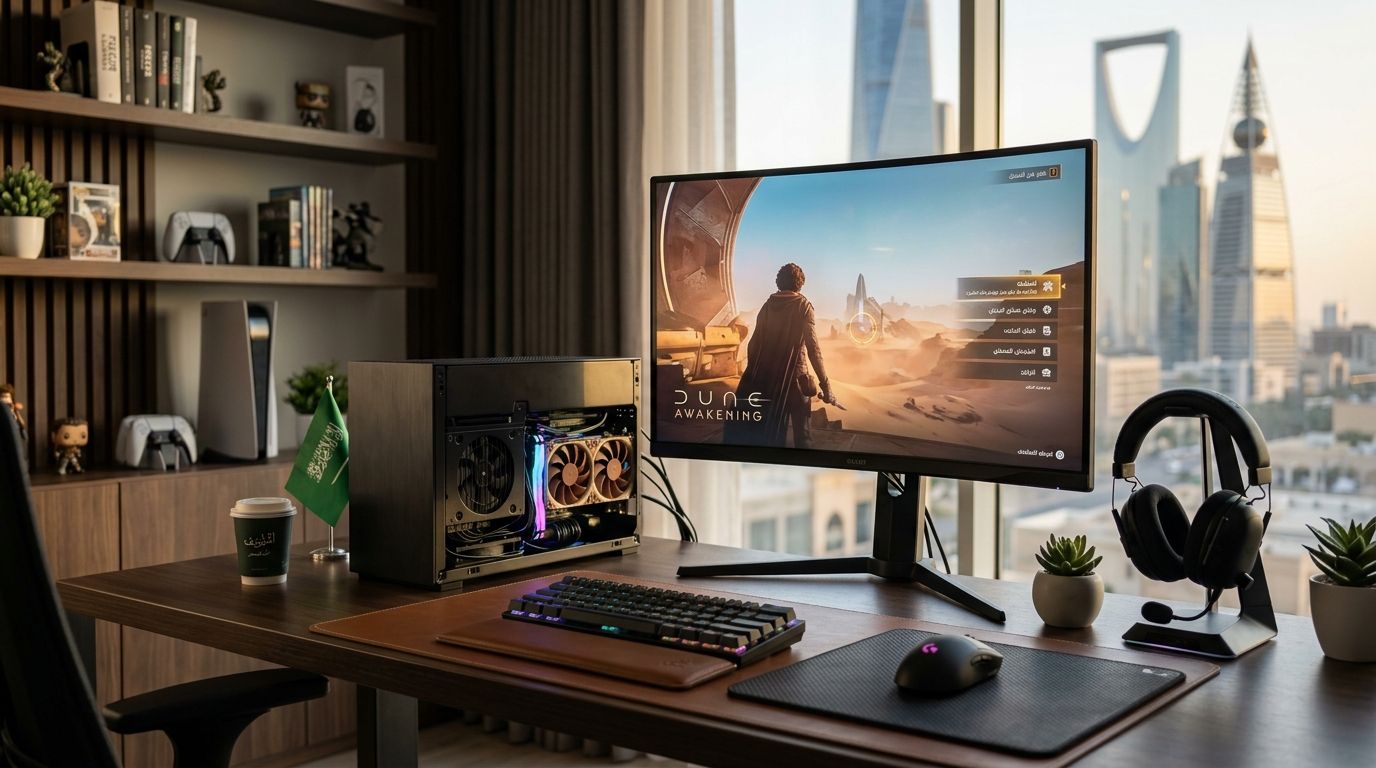
Mini ITX gaming PCs pack full desktop performance into a case small enough to hide under a monitor arm or carry to a LAN night, and in 2026 the compact form factor no longer means compromise on GPU power in Saudi Arabia. This guide ranks the mini ITX gaming PC builds worth buying, what each one is actually good for, and where the form factor still forces trade-offs.
- Best overall mini itx gaming pc in 2026: a custom Gamerzone build with an RTX 5070 Ti in a compact ITX case.
- Best for AMD buyers: a Gamerzone mini ITX build around the RX 9070 XT for strong rasterization per liter of case volume.
- Best budget option: an entry Gamerzone mini ITX build that skips high-end GPUs but keeps upgrade headroom.
- GPU clearance and SFX PSU wattage decide which cards actually fit — check both before ordering.
Best overall: Gamerzone's custom RTX 5070 Ti mini ITX build. Best for AMD fans: the RX 9070 XT mini ITX build. Best budget option: the entry mini ITX build without a flagship GPU.
Why this matters
Mini ITX cases in 2026 max out around 300-330mm of GPU length and 155-165mm of GPU height in most airflow-focused chassis, which rules out the longest triple-slot flagship cards even when the rest of the build could handle them. Get the case-to-GPU match wrong and the card either doesn't close the side panel or throttles from starved airflow within minutes of a gaming session. A custom gaming PC built specifically around ITX constraints avoids that mismatch from the start.
The other bottleneck is the power supply. Mini ITX builds almost always run SFX or SFX-L PSUs instead of standard ATX units, and SFX-L wattage tops out around 850W in common retail units — enough for an RTX 5070 Ti but tight for anything pulling more sustained power under a 2026 workload.
What makes the best mini ITX gaming PC
- GPU clearance — length, height, and thickness the case actually supports without modding
- PSU form factor and wattage — SFX vs SFX-L, and whether it covers the GPU's transient power spikes
- Cooling headroom — air tower vs low-profile AIO, and whether the case supports 240mm radiators
- Motherboard chipset — VRM quality on the single ITX board slot, since there's no swapping later
- Cable management — SFX cases have far less routing space than mid-towers, so pre-sleeved cables matter more
- Airflow under load — dense component packing means thermal throttling risk is higher than in ATX builds
Mini ITX gaming PC builds at a glance
| Build | Best for | Standout feature | Key limitation |
|---|---|---|---|
| RTX 5070 Ti mini ITX | Best overall | Flagship-tier rasterization in a compact case | Needs a case rated for 300mm+ GPU length |
| RX 9070 XT mini ITX | Best for AMD fans | Strong rasterization per liter of case volume | Ray tracing trails Nvidia at the same tier |
| Entry mini ITX | Best budget option | Lowest footprint, easiest airflow | No headroom for future flagship GPU upgrade |
| 4K mini ITX | Best for 4K gaming | Tuned for high-resolution frame pacing | Larger radiator needs cut case options down |
| LAN/travel mini ITX | Best for portability | Lightest case, easy one-hand carry | Cooling budget forces GPU compromise |
1. RTX 5070 Ti mini ITX build: best overall mini ITX gaming pc
This configuration pairs an RTX 5070 Ti with a mini ITX motherboard in a case built around 300mm+ GPU clearance, which is the sweet spot for 2026's mid-to-high tier GPUs without forcing a case upgrade. It runs modern titles at 1440p high refresh with headroom left for ray tracing when the scene calls for it. Airflow-focused ITX cases keep this card cool without the throttling that older, denser designs suffered.
RTX 5070 Ti mini ITX pros:
- Handles 1440p high-refresh and light 4K without a case swap
- SFX-L PSU wattage (up to 850W) covers this card's power draw with margin
- Fits cases with 240mm AIO support for sustained thermal headroom
RTX 5070 Ti mini ITX cons:
- Case options narrow fast once GPU length crosses 320mm
- SFX-L PSUs cost more per watt than standard ATX units
Best for: gamers who want ATX-tier performance without the ATX-tier desk footprint.
Verdict: Buy.
2. RX 9070 XT mini ITX build: best mini ITX gaming pc for AMD fans
The RX 9070 XT delivers rasterization performance close to Nvidia's competing tier at a smaller physical footprint on some board partner cards, which matters more in ITX than in any other form factor. It's the pick for gamers running rasterization-heavy titles rather than ray-traced showcases. Driver maturity and VRAM allocation on this card have both improved through 2026, closing the gap that used to favor Nvidia in compact builds specifically.
RX 9070 XT mini ITX pros:
- Strong price-to-performance for rasterization-heavy game libraries
- Runs cooler per watt than some RTX equivalents in tight ITX airflow
- Compatible with the same 300mm-class ITX cases as the RTX 5070 Ti tier
RX 9070 XT mini ITX cons:
- Ray tracing performance still trails Nvidia's equivalent tier
- Fewer ITX-specific board partner SKUs than the Nvidia side
Best for: AMD-loyal gamers who prioritize rasterization frame rates over ray tracing fidelity.
Verdict: Buy.
3. Entry mini ITX build: best budget option
An entry mini ITX build skips flagship GPUs entirely and focuses on a mid-tier card paired with a smaller, cheaper SFX PSU and a compact air cooler instead of an AIO. It's built for 1080p and light 1440p gaming rather than 4K, and it keeps the whole footprint — case, PSU, cooler — proportionally smaller than the higher tiers above. The trade-off is straightforward: less GPU headroom in exchange for the smallest, quietest build on this list.
Entry mini ITX pros:
- Smallest case footprint of any build in this guide
- Lower PSU wattage requirement keeps cost and heat down
- Easier airflow management with a smaller mid-tier GPU
Entry mini ITX cons:
- No realistic upgrade path to a flagship GPU without a case swap
- 4K gaming is off the table without frame generation reliance
Best for: gamers who want a compact PC for 1080p/1440p without paying for headroom they won't use.
Verdict: Buy for 1080p and 1440p. Skip if 4K is the target.
4. 4K mini ITX build: best mini ITX gaming pc for 4K gaming
A 4K-focused mini ITX build pushes toward the top of the GPU clearance and PSU wattage limits this form factor allows, usually landing on the same RTX 5070 Ti tier but paired with a case that supports a 240mm radiator instead of an air tower. Sustained 4K workloads generate more heat over longer sessions, so the extra radiator surface area matters more here than at 1080p or 1440p. Case selection narrows considerably once both 300mm+ GPU length and 240mm radiator support are required together.
4K mini ITX pros:
- 240mm AIO support keeps sustained 4K thermals in check
- Same GPU tier as the overall pick, tuned for resolution over pure fps
4K mini ITX cons:
- Very few ITX cases satisfy both GPU length and 240mm radiator requirements
- Costs more than the 1440p-focused overall build for a resolution jump
Best for: gamers set on 4K who still want the smaller case footprint.
Verdict: Buy if 4K is non-negotiable.
5. LAN/travel mini ITX build: best mini ITX gaming pc for portability
This build prioritizes the lightest case and smallest total volume over raw GPU tier, which means a mid-range GPU instead of a flagship one. It's built for gamers who move their PC between a desk setup and LAN events or a friend's place regularly, where case weight and handle placement matter as much as frame rate. Cooling budget is the clear trade-off — smaller cases mean smaller fans and less radiator space.
LAN/travel mini ITX pros:
- Lightest, most portable case in this guide
- Easiest one-hand carry with integrated case handles
LAN/travel mini ITX cons:
- GPU tier is capped lower to protect thermals in the smallest cases
- Less headroom for future GPU upgrades than the other builds
Best for: gamers who transport their PC often and rank portability above peak fps.
Verdict: Buy for portability. Hold if the PC stays on one desk permanently.
How this ranking works
Each build above is scored against the same six criteria: GPU clearance, PSU form factor and wattage, cooling headroom, motherboard VRM quality, cable management, and airflow under sustained load. The RTX 5070 Ti build wins overall because it clears every criterion without forcing a case-specific compromise; the other four builds each trade one criterion (GPU tier, cooling, or portability) for a specific use case instead.
Which mini ITX gaming PC should you choose?
Pick the RTX 5070 Ti mini ITX build if you want the least compromise across resolution, ray tracing, and case size in 2026. Go AMD with the RX 9070 XT build if your library leans rasterization-heavy and ray tracing isn't a priority. Choose the entry build for 1080p/1440p on a tighter budget, the 4K build if resolution is non-negotiable, and the LAN/travel build if the PC needs to leave the desk regularly.
FAQ
What's the best mini ITX gaming PC in Saudi Arabia in 2026?
A custom mini ITX build with an RTX 5070 Ti is the best overall pick in 2026, fitting standard 300mm-class ITX cases without cooling compromises. It handles 1440p high refresh and light 4K without a case upgrade.
Is a mini ITX gaming PC good for 4K gaming?
Yes, a mini ITX build with an RTX 5070 Ti and a case supporting a 240mm radiator handles 4K gaming in 2026. Case options narrow considerably once both GPU length and radiator size requirements are combined.
How much GPU clearance does a mini ITX case need?
Most airflow-focused mini ITX cases in 2026 support GPUs up to 300-330mm in length and 155-165mm in height. Confirm exact card dimensions against the case spec before ordering, since triple-slot flagship cards can exceed these limits.
Can a mini ITX gaming PC handle an RTX 5090?
Only a small number of mini ITX cases and SFX-L power supplies support an RTX 5090's length and power draw. For most builds, the RTX 5070 Ti is the practical ceiling for a mini ITX case in 2026.
Is mini ITX more expensive than ATX for the same specs?
Mini ITX builds typically cost more per component tier than ATX because SFX and SFX-L power supplies and compact coolers carry a premium. The extra cost buys a smaller footprint, not extra performance.
What PSU form factor do mini ITX gaming PCs use?
Mini ITX gaming PCs run SFX or SFX-L power supplies instead of standard ATX units. SFX-L units commonly reach up to 850W, which covers most GPUs up to the RTX 5070 Ti tier.
Are mini ITX gaming PCs good for LAN parties?
Yes, a mini ITX build with a lightweight case and integrated handles is the most practical option for LAN parties and travel in 2026. The trade-off is a lower GPU tier to protect thermals in the smaller case.
Does Gamerzone build custom mini ITX gaming PCs in Saudi Arabia?
Yes, Gamerzone configures custom and pre-built gaming PCs, including mini ITX builds, for buyers across Saudi Arabia. Component selection is matched to case size, GPU clearance, and cooling requirements before assembly.
One last thing
The single most common mini ITX build mistake isn't the GPU choice — it's ordering a case before confirming SFX-L PSU wattage against the GPU's actual transient power spikes, which can exceed the card's rated TDP by a wide margin under load. Check PSU wattage against GPU power draw before locking in a case, not after.